
So you want to get into mountain biking in perhaps one of the world’s least supportive places for mountain biking? Perfect!
- Choosing a bike.
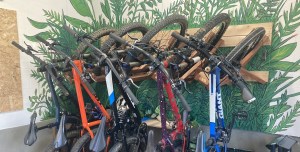
The ideal bike for your Okinawa adventures will depend on what sorts of capabilities you will need to enjoy your ideal adventure.
Since a lot of our routes combine long cruises with the gnarliest trails you’ll have to consider what elements are most important, or because it’s an island, what’s even available. Here we’ll discuss bike categories based on the type of riding they are capable of.
Chill Bikes
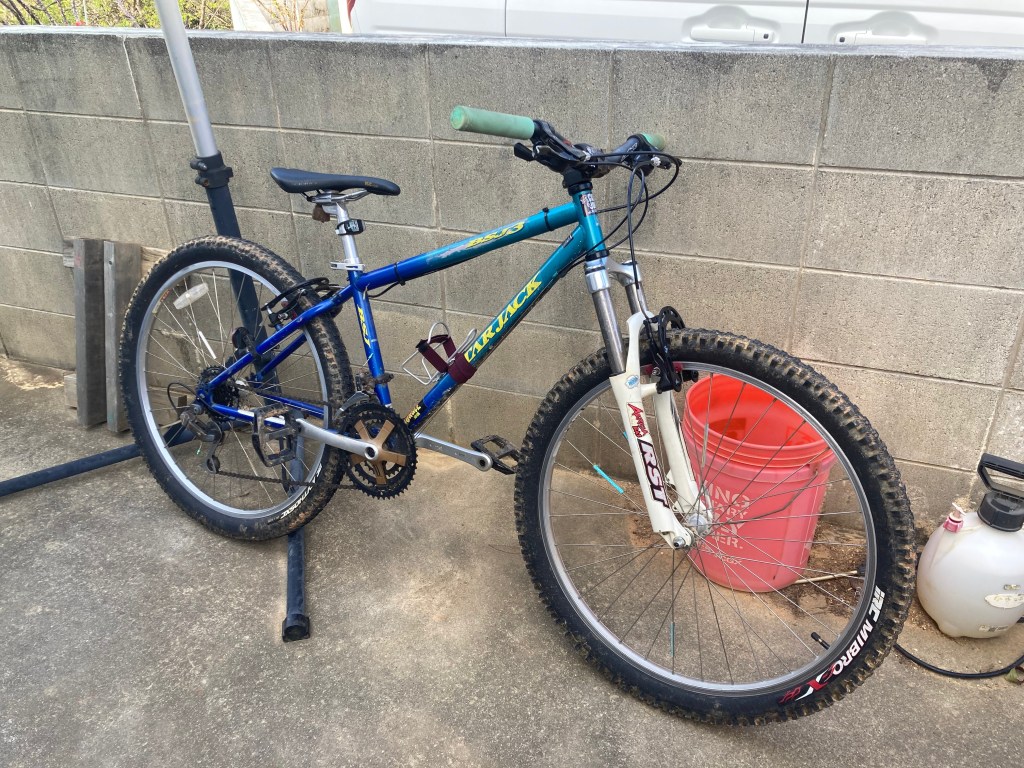
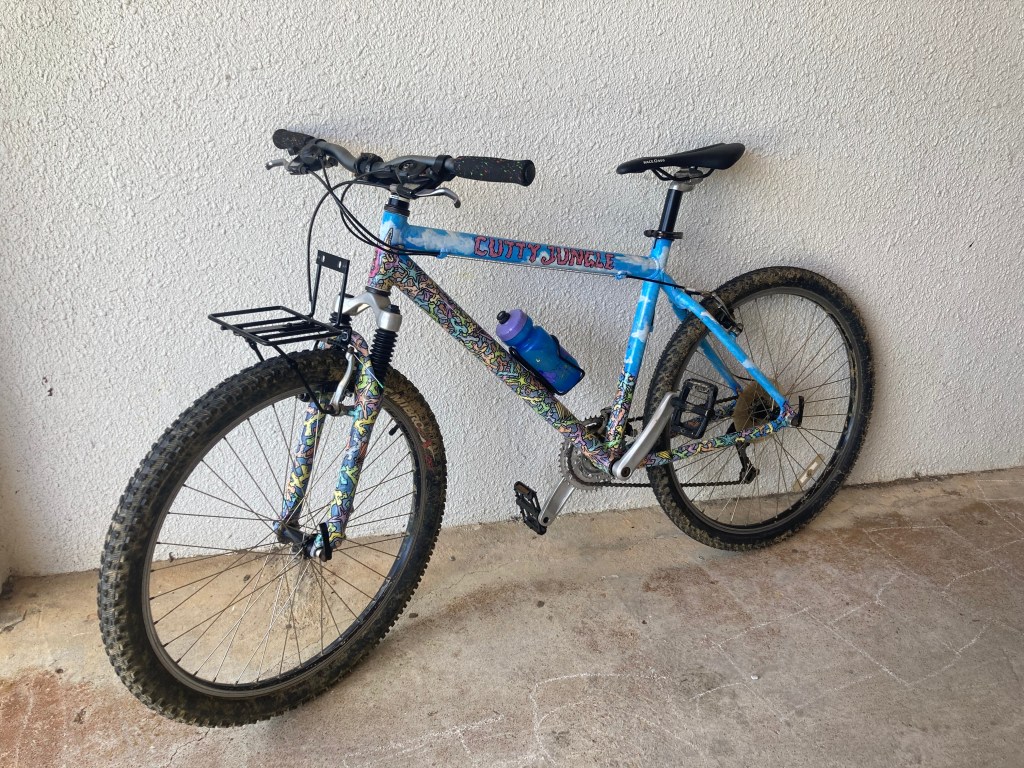
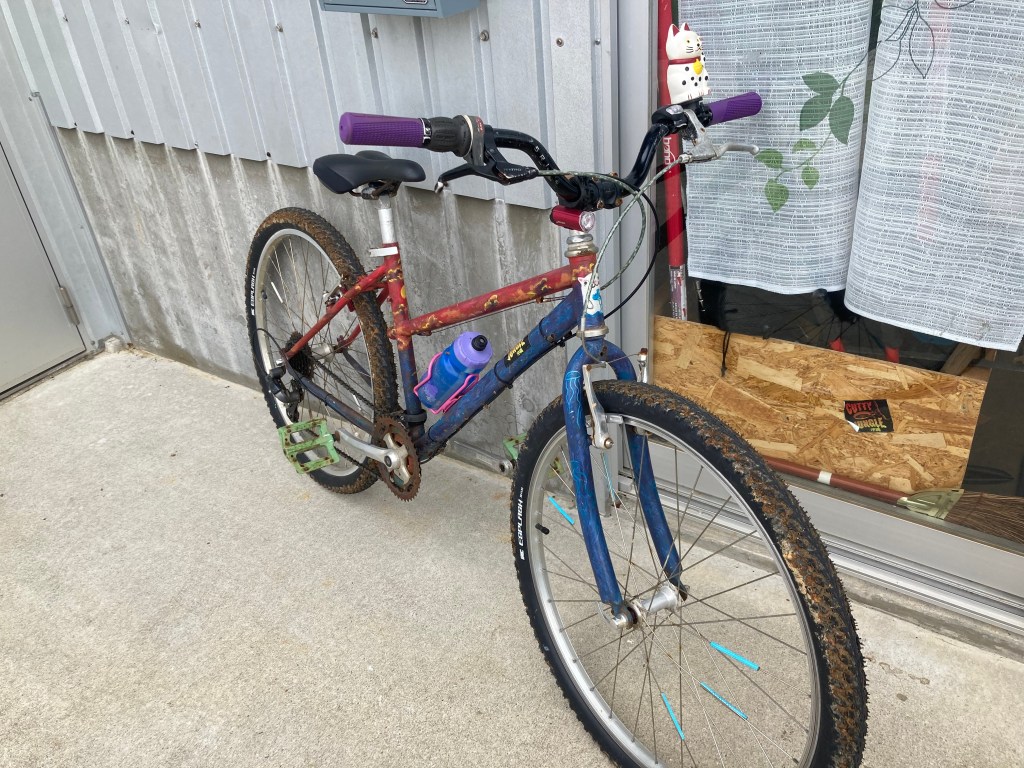
These types of bikes are great for long adventures that include dirt and backroads, light trails, or tons of traversing on pavement. They climb well, are smooth and efficient, and give you enough control for cruising and maybe even doing a little more! The multiple chainrings up front grant wide gear ratios for easy propulsion. In this category we’ll include bikes that have tires that are happy on the dirt and the pavement, have minimal if any suspension, and reliable v-brakes or disc equipped gravel bikes. These bikes are only appropriate for some of the routes.
XC bikes and Trail Hardtails
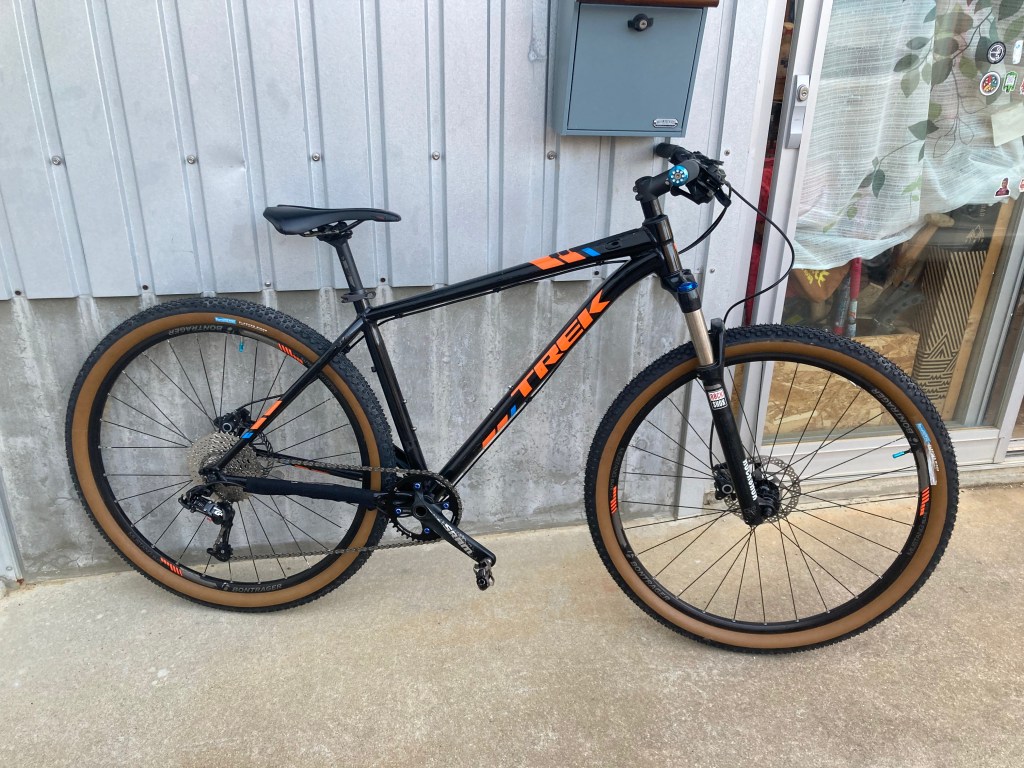
xc hardtail, narrow tires, adequate brakes, 100mm suspension 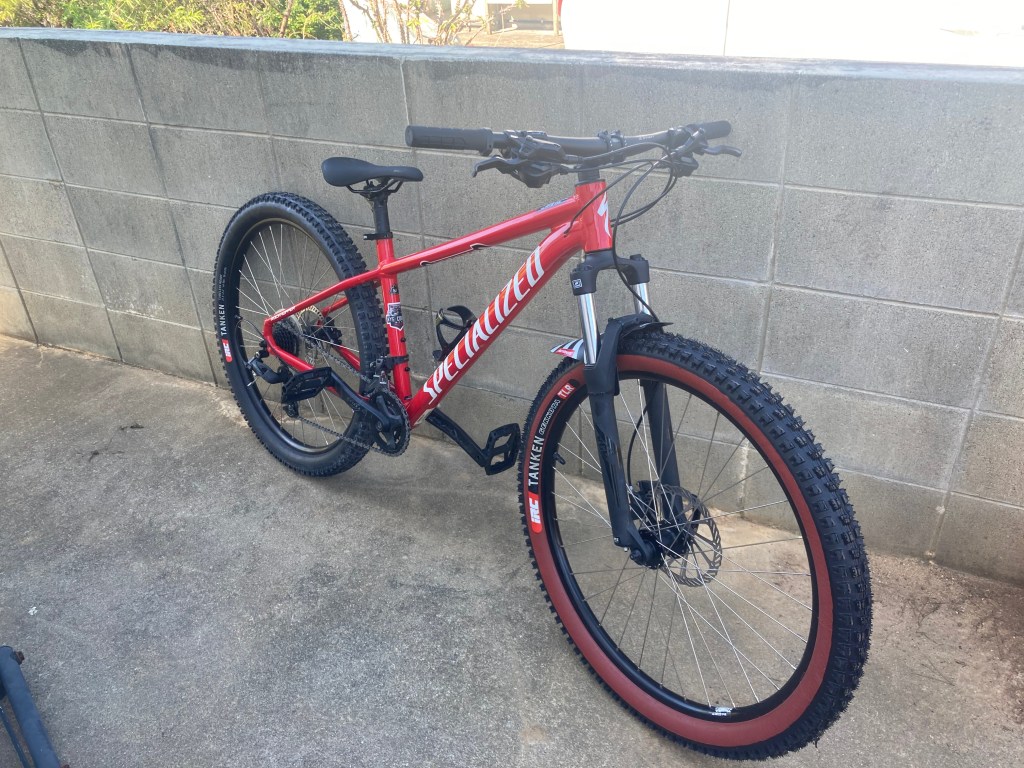
general purpose trail hardtail. Not a true hardcore hardtail, but light and capable of anything 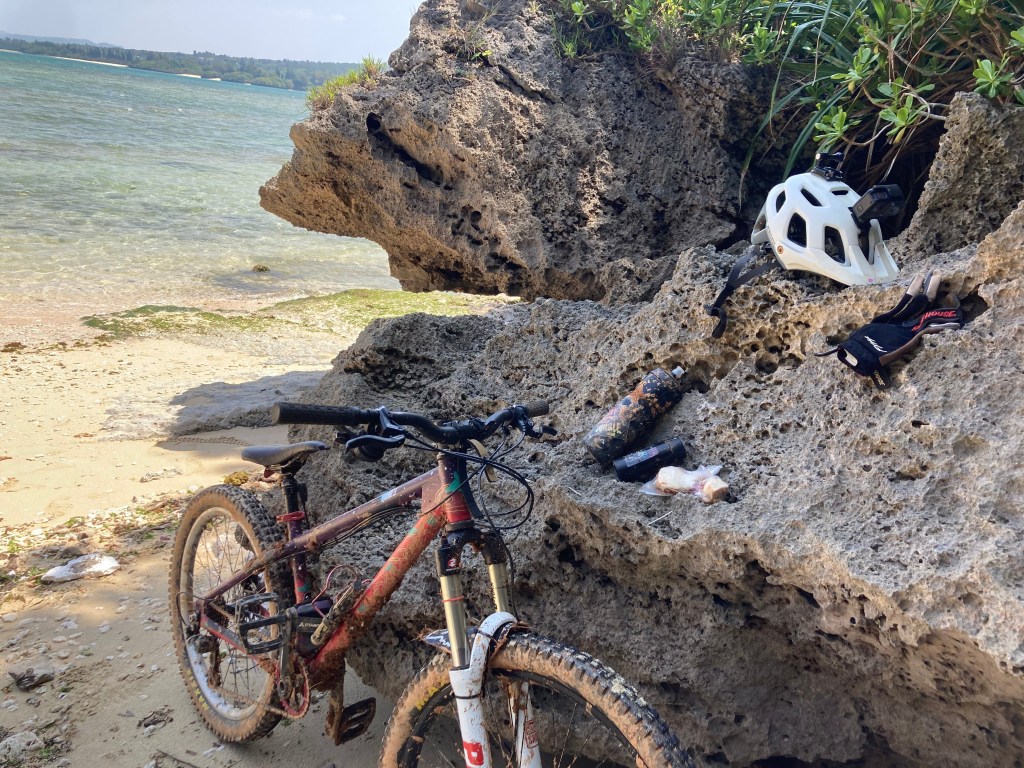
a 19 year old steel trail hardtail. 140mm fork, aggressive tires, 4 piston brakes 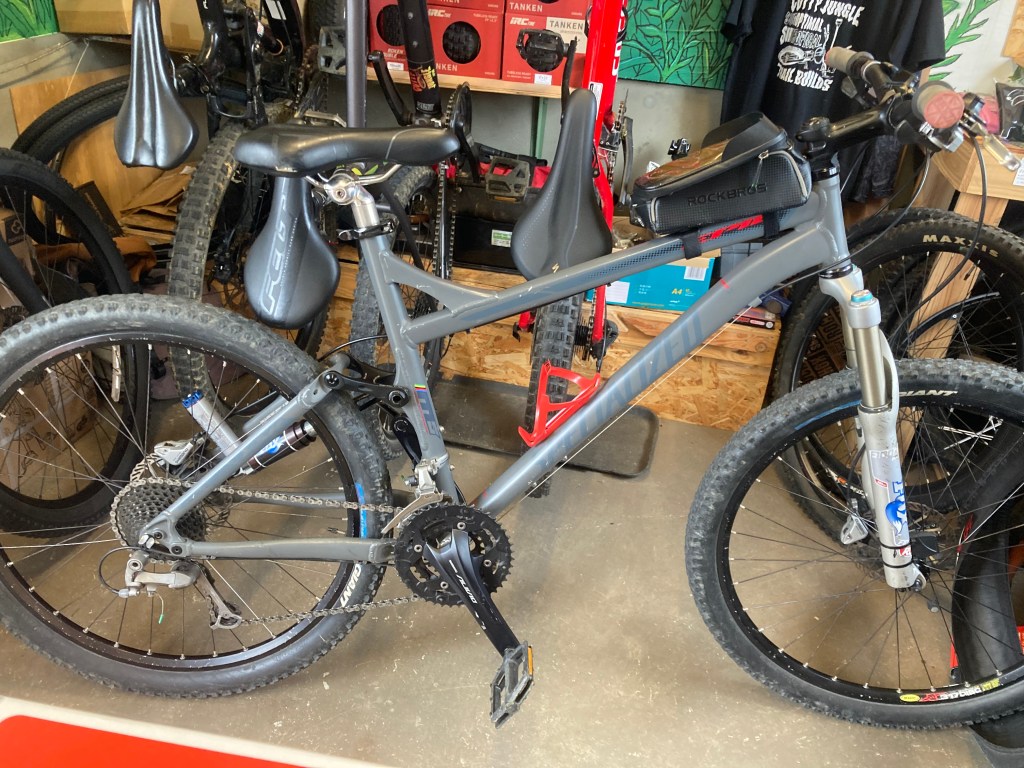
22 year old xc full suspension. Efficient in climbs and flat trails, but less stable in technical downhills.
These bikes are great for a number of reasons, and are capable enough for the gnar, while also being efficient and fun for the cruises. Some may say they are the ideal Okinawa adventure bike! That said, even this category of bike comes in a lot of flavors. XC bikes are made with pedaling efficiency in mind and often have narrower tires with smaller faster knobs, about 100-120mm of suspension and 2-piston hydraulic brakes. Trail hardtails also get into this category since they have similar capabilities except trading efficiency for more stability, traction, and hit absorption. Their frame geometry allows for greater range of motion when the rider needs to get the most from the bikes handling potential. Our trail hardtail rental has 2.6″ wide tubeless tires made with a competition trials motorcycle compound. Trail hardtails also feature more capable brakes, stronger suspension chassis, and sometimes a dropper seatpost. The XC bikes can be babied though any route, but the trail hardtails can blast through with more confidence.
Full Suspension Trail
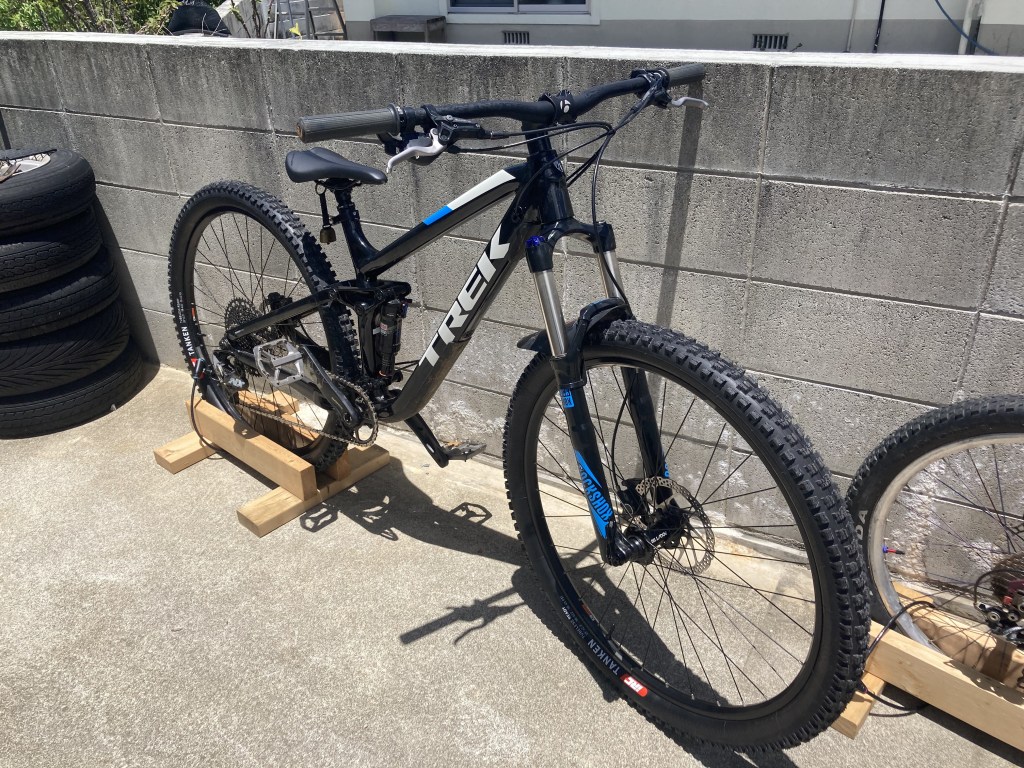

Full suspension trail bikes are the perfect bike for our most aggressive trails. While there are more downhill oriented bikes, they weight more which can be a nightmare when it comes time to carry the bike up 200 stair steps. Also our trails are not fast enough to make use of a dh bike. Our rental fleet consists of 2019 and 2021 bikes which are a sweet spot in geometry design theory. The bikes are slack and stable at our trail speeds while being responsive enough for the technical bits and being enjoyable enough on the climbs. I actually find that the 2021 Trek Fuel ex5 climbs better than my personal 2008 hardtail. These bikes also lack a front derailleur, instead relying on wide range 12 speed cassettes with high tech derailleurs and chainrings to keep things consistent so you don’t have to worry about the drivetrain when operating these bikes and focusing on the trail.
Features Guide
Not every bike is easy to put into a category, and sometimes that’s what makes it perfect for what you want to do. But say you want your own adventure bike and see a few on Facebook Marketplace and aren’t sure what you’re looking at. Here’s a quick guide:
Frame types:
Hardtails seem basic but there’s a lot going on. First, let’s talk quality. The vast majority of bikes on Facebook marketplace will be a health hazzard in the trails. Many have heavy steel frames with crappy parts to create a bicycle inspired thing, often shaped to look like hydroformed aluminum which means even more heavy material without the benefit of adding strength or rigidity. But an aluminum frame doesn’t mean a better bike either. Many cheaper bikes are meant to just roll around the park and only come in one size: no ones. Often they’ll have the wheel size be the factor that governs what size rider the bike is meant for. The frames are designed to comfortably allow a huge range of riders from 4’10” to 6’4″ but not be ideal for anyone. Toptubes too short for tall riders and chainstays too long for short riders are common traits that most newer riders won’t be able to identify or notice, until they start to expect the bike to handle trail situations.
So what does make a good frame? Well-made frames often are made in multiple sizes, of either aluminum or steel, and the best ones will be relatively light yet rigid enough to not flex under braking and durable enough to survive use in the trails. It’s hard for the untrained eye to discern, and while Googling may help, you could always ask us what we think about something.
Geometry and suspension is the next big thing to look at with frames. XC bikes tend to have steeper angles and sharper handling, trail bikes will have more slanted shapes handle slower but with more stability.
Suspension:
Any suspension body that is made of steel will be pretty low quality. With forks we’re talking the lowers, aside from rust showing through chipped paint, the dropouts (part that holds the hub axle) will be thin and welded. Quality fork lowers will always be made of cast magnesium. The stanchions (part that slides into the lowers) may be made of steel on some lower end forks and are susceptible to rusting and pitting. Forks that do not use an oil bath for lubrication also tend to murder their bushings and develop play. Not sure if it’s the dry mechanism itself or the fact that dry forks are pretty much always low quality.
With rear shocks you can identify trash by it just looking like a stick in a spring. Though I have also seen a cartridge style air shock once that couldn’t be adjusted at all. Generally any suspension component with no functional adjustment dial is no good. By no good, I mean they will offer no dampening and probably move with tons of stiction and flex. There are very high quality coil shocks that will usually have a fancy looking body with an adjustment dial and sometimes an external reservoir.
Brake types:
Band brakes, stay away from these. They are on bikes that the maker deemed unworthy of V-brakes. They somehow are a popular choice for electric powered family bikes you ride with two kids on. You can think of them as drum brakes, except with absolutely no brake feel or potential. You can consider any bike equipped with these as unsafe for any of our routes.
V-brakes are what I’d recommend as the minimum for even our easiest routes. And not all V-brakes are the same. You want something with thick aluminum arms instead if thin stamped steel. Aluminum arms are more likely to be more rigid. But even then, a flimsier frame might flex under braking and kill the performance.
Mechanical Discs are roughly in the same category of braking potential as V-brakes, but with better wet weather performance. They’re feel will be less fluid than hydraulic brakes and therefore offer less controllability, making it trickier to maintain traction in the dirt. They also require way more lever pull especially on steep sections. Like V-brakes, they come in a variety of qualities and unlike the v-brakes, calipers that use steel in the cam arm actually provide more rigidity under braking when looking at cheap models. Expensive ones do exist for some reason.
Hydraulic Discs are considered mandatory for our most difficult trails. While most models are capable of adequate braking performance, they are very susceptible to deteriorated pads and rotors and require a bit of care. But if you want the most control and braking potential, they are the only way to go.
Drivetrains:
1x drivetrains, meaning no front derailleur, you only shift through the rear cassette, are very much in style and will be the standard since five years ago. A true 1x drivetrain will utilize a special feature in the rear derailleur that uses springs and friction pads, yes, a clutch. This special tech keeps the pulleys in position and not flopping around. The extra tension helps keep the chain in line. Essential to this system is a specially designed chain ring that has alternating narrow and wide teeth to grip the chain To compensate for the lack of front shifting, the cassettes are usually massive, with up to a 52t gear as opposed to a 32t on a normal 3×9 drivetrain.
2x and 3x arn’t completely outdated, just less nice in rougher conditions. Front derailleurs are annoying to tune and easy get bent or out of positiion. But they do offer good range without needing a massive gear cassette. They’re great for our longer distance cruises.
Freewheels are what you need to look out for. If the bike isn’t 20 years old, having a freewheel is a great death machine indicator. These contraptions will usually have a 6 or 7 gear cluster with the highest (smallest) gear being a 14t rather than a 11t on an HG cassette. They also tend to use twist shifters. These will also be paired usually with an ugly derailleur that looks homemade. You can’t just go by brand either because Shimano makes some of the best stuff, but they also make an ugly derailleur just for these trash bikes.
Tires:
XC and bike path tires are generally lower volume and about 1.9-2.2″ in width. They have littler knobs, usually pretty closely packed, and a very round profile. They are stable and fast on pavement, and just adequate for dirt paths. They are great for our less gnarly routes. But will quickly get squirrely in jungle trails.
Light Trail tires such as the IRC Mibro-X tires (for 26″ tubed wheels) can perform great in the trails when they are dry. They come in widths of about 2.25-2.4″ Compared to the hardcore trail tires, they feel very fast and light, and if the conditions are harder can provide more cornering support. They have an aggressive pattern but low knob height. So while they can shed mud kind of well, they can also get overwhelmed since they can’t penetrate that deep.
Trail tires have DH type knob patterns, a wider 2.3-2.8″ width, and durable casings, but not as heavy or durable as a true DH tire with double wall casings. They often have the stickiest compounds and the tallest knobs. Some models lack transition knobs and need the rider to have higher handling skills to make use of the very sticky shoulder knobs. But many like the IRC Tankens on our rentals reduce that gap to ensure a high traction feel no matter how the tire is leaned. If you want to ride without worrying if your tires are good enough, trail tires are the way to go for Okinawa trails.
Most performance oriented tires these days will be tubeless ready. This designation means the tires construction is supportive enough to hold sealant and be repairable. A high-quality non tubeless ready tire may work such as the IRC Mibro-x or Kenda Nevegal, but lower end tires often won’t have the construction quality to support it. The sidewalls need to be rigid enough to hold the tires shape without the support of a tube, and also to hold repair plugs.
Rims:
Some rims are designed for rim brakes, but you likely won’t see them on the trails. So here we’ll talk about rims for disc brakes. Two things to consider are width and tubeless compatibility.
Width influences what width tire you can safely run. Many lower end bikes will come with rims with an inner width of less than 20mm. These narrower rims will accommodate 1.9-2.25″ tires best. You can run wider, many have, but that will make the tire have a very rounded profile, which some like, but all that extra tire mushrooming out has less support. If you intend to run low air pressures, this could get bad.
25mm seems to be pretty standard for a lot of entry level mountain bikes. These will take some 2.3″ tires pretty well, but on higher volume tires, they can still have a mushroom effect. For a hardcore trail rider, this lack of support can result in the tires unseating from the bead.
30mm is a pretty sweet spot for most trail bikes, allowing even 2.6″ tires. 35mm gives you even more support, but running a narrower such as 2.3″ tire will result in a more square profile. Our smaller full suspension rental has 35mm rims and runs a 2.6 in the front and 2.3 in the rear. A neutral semi-round profiled front tire for initiating and holding turns, and a squarish rear tire that has tremendous braking potential.
Tubeless rims are designed to accommodate a tubeless setup. While many non tubeless rims have been successfully used to run tubeless setups, they often are not profiled to effectively accommodate tubeless specific rim tape and often have unsealed joints. Pumping a ton of sealant may work short term, but not reliably.
dropper seatposts:
These are a luxury item that does make riding way more convenient. It grants the rider the ability to change the seat height while riding. So when the trail is flat or going uphill you can extend the seatpost for more pedaling efficiency. But if there’s an obstacle such as a fallen branch that you need to perform a dynamic move to get over, you can drop the seat height instantly to give your body for clearance to get dynamic. I rode for 17 years without one, only upgrading to dropper posts last year. Before then, most of my riding just involved some paved pedaling, then walking the bike up hills to plow down after. But since we have longer routes and many trails that require pedaling while also having obstacles and short gnarly descents on the way to the top, the ability to change seat heights while riding has made that a lot nicer.
Seats:
The perfect one is going to depend on the rider’s shape down there and what they want from the seat. There is more than just comfort! A lot of newer riders like the fattest seat they could find. If you plan on just sitting and cruising, that makes a lot of sense. Sticking with comfort, on longer rides the shiftiness of all that material can also lead to pressure where you don’t want it. Even more annoying, it can easily be in the way when trying to move your body around the seat for dynamic moves. That’s why sportier seats are generally going to be narrow and have less padding. There’s an infinite variety of seats that all balance these things. A lot of riders will start off with a preference for something sporty shaped yet cushy, but as their skills progress and they start to learn that it’s way better to absorb hits with your legs than your butt, and get more comfortable moving around the bike, they tend to desire less of a padded seat and something more streamlined and allows easy maneuvering. The weight savings are also nice.
But even if you go straight to a performance oriented seat, there’s also a billion shapes of these. There is a trend with road and xc bikes that use shorter wider seats (about 250x150mm vs more traditional 280x140mm seats). They have a more Dorito shape and are attractive to some because they are lighter and favor a seating position that has your butt kind of planted on the back and supposedly promote more powerful use of your legs. I don’t know about any of that. But I do know that it is generally unfavored by trail mountain bikers that use more body motion. Trail bike seats tend to use the traditional shape, kind of bulging at the base then sticking way out in front. This gives you something compact to sit your butt on when pedaling and ahead of that there’s clearance on the sides for pedaling and dipping the bike side to side. I’ve read stuff about how the longer length also lets riders slide forward on the tip, I don’t do that, but whatever.
With that in mind, I highly discourage use of seats with plastic bits that stick out the side of the wider part of the seat or behind it, past the padding. Since you will be actively moving around and off the seat, the plastic parts will attack your inner things and sometimes your base. Explaining the bruises and marks later gets weird.
By now you’re probably wondering what’s up with the void down the center of many seats. So that is meant to get pressure off the part in front of your butt. Not all seat designs use this, and not all voids feel the same. I’ve used seats without the void that I found comfortable for extended seating and pedaling, but also some with a void that I hated. Not sure what’s going on exactly. But my current favorite seat is a shorter trail seat with the void.
And to further complicate it, the angle of the seat makes a huuuuuge difference in how you perceive the seat. Some seats have a kind of concave seat that makes setting the postion annoying because if you set the rear to be flat with the ground, then the mid and front are up, and all up on your parts. For the most part, a seat pointed down will be easier on your situation, particularly when climbing or pedaling seated on flats. But that also means the rear is pointed up. If you’re dropping your weight back and behind the seat on a descent and your bike loses speed faster than your arms and legs (assuming you don’t slip the pedals) can brace for, you are going balls to the wall, and that wall is the back of that bike seat, except it’s a concentrated and precise strike rather than an actual wall. You can die. Maybe. So that’s why descenders will often angle their seats nose up. It also gives you more dipping clearance.
 CUTTY JUNGLE OKINAWA - MTB Bike Repair, Tours, and Rentals